
October 20, 2026 · 13 min read
The Biggest Problem With the Secondary Luxury Watch Market

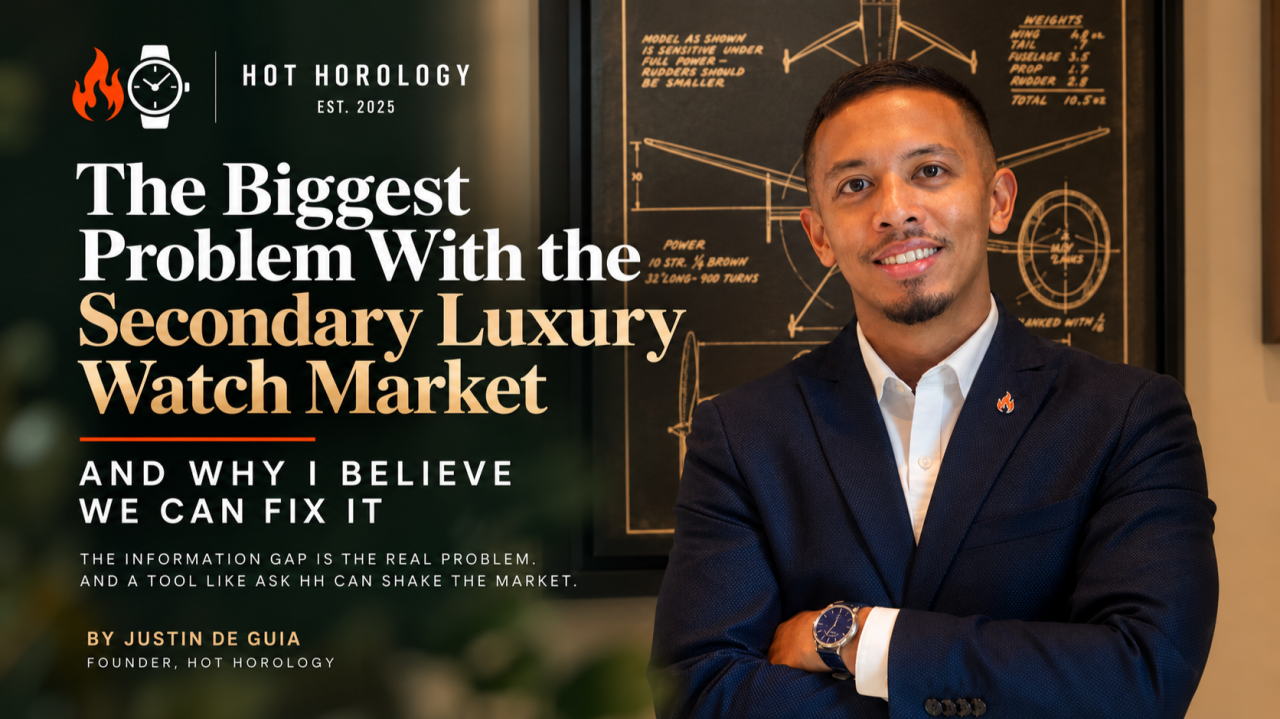
Why I Believe "ASK HH" Can Shake Up the Entire Industry
After nearly 15 years working in the luxury watch industry, from selling watches on the retail floor to managing Rolex and Tudor boutiques, I’ve learned a lot about how this business operates.
I’ve seen how watches are sold, how customers make purchasing decisions, and how important knowledge and relationships are in this industry.
But since leaving traditional retail and starting Hot Horology, one issue has become increasingly clear to me.
The biggest problem with the secondary luxury watch market isn’t the prices themselves. It’s the information gap between buyers and sellers.
And I genuinely believe this is one of the biggest problems in our industry.
For years, professional watch dealers have had access to market information that the average collector simply doesn’t. Historical pricing, wholesale values, supply, demand, liquidity, and actual transaction data.
Meanwhile, the average collector is often relying on Google searches, advertised prices, or whatever someone tells them their watch is worth.
Think about that for a second.
You’re making a $10,000, $20,000, or even $50,000+ financial decision, and the person on the other side of that transaction potentially has significantly more information than you do.
That’s a problem.
And it’s exactly what we’re trying to change with ASK HH.
1. Asking Price Is NOT Market Value
This is probably the biggest misconception I see in the secondary watch market.
Someone wants to know what their Rolex is worth.
What’s the first thing they do?
They Google it.
They search Chrono24, eBay, or another marketplace, find a few examples listed for $15,000, and immediately assume their watch is worth $15,000.
But here’s the issue.
Just because someone is asking $15,000 doesn’t mean someone is actually paying $15,000.
A watch could sit on the market for months at that price.
It might eventually sell for $13,500, or it might not sell at all.
Yet those asking prices continue influencing what other people believe their watches are worth.
This creates a cycle of unrealistic expectations, inflated asking prices, and confusion about actual market value.
The true market isn’t determined simply by what someone wants for their watch.
It’s determined by what buyers are actually willing to pay, supported by comparable transactions, historical pricing, current supply, demand, condition, and liquidity.
Without that information, you’re guessing.
And when you’re dealing with watches worth thousands of dollars, guessing can become expensive.
2. The Information Gap Has Benefited the Industry for Years
Here’s where I believe the real problem begins.
Professional watch dealers have traditionally had access to resources, networks, and information that most collectors don’t.
They understand wholesale pricing.
They know what comparable watches are actually trading for.
They understand which references are desirable, which ones are difficult to move, and where the market is heading.
That knowledge gives them an advantage.
And to be clear, there’s absolutely nothing wrong with having experience or being knowledgeable.
I spent nearly 15 years in this business. I understand the value of expertise.
But there’s a difference between making money because you provide a valuable service and making money because the other person doesn’t understand the market.
I don’t have a problem with dealers making money. I have a problem with an industry where the average collector is at a significant informational disadvantage.
Imagine walking into a car dealership without access to Kelley Blue Book, comparable sales, or any reliable way to estimate the vehicle’s value.
You’d essentially have to trust whatever the dealership tells you.
Now imagine doing that with a $30,000 Rolex.
That’s the reality for many collectors navigating the secondary watch market.
And I believe that needs to change.
3. Buyers Are Potentially Overpaying Without Even Knowing It
Let’s say you’re shopping for a Rolex Submariner.
You find one listed for $16,000.
You search online and see several other examples listed for similar amounts.
Naturally, you assume $16,000 must be a reasonable market price.
But what if comparable watches have actually been trading closer to $14,700?
That’s a difference of $1,300.
On one watch.
And you might never know.
Now multiply that across thousands of transactions happening throughout the secondary market.
Think about how much money consumers could potentially be overpaying simply because they don’t have access to better information.
I’m not suggesting every watch should sell at the same price.
Condition, completeness, service history, warranty, seller reputation, and convenience all affect value.
A reputable dealer may absolutely deserve to charge a premium for the services and protections they provide.
But the buyer should understand that premium and be able to decide whether it’s worth paying.
There’s a big difference between knowingly paying more for something and overpaying because you didn’t know any better.
That’s why transparency matters.
4. Sellers Are Leaving Money on the Table
The information gap doesn’t just hurt buyers.
It can hurt sellers just as much.
Three of the most common questions I receive are:
What’s my watch worth?
How much should I list it for?
Is this a good deal?
These questions might sound simple, but getting reliable answers isn’t always easy.
Imagine you own a watch that you haven’t worn in years.
You decide to sell it.
You contact a dealer, and they offer you $8,000.
You don’t really know what the watch is worth, so you accept.
But what if comparable watches are selling for substantially more, and other dealers would have offered you $9,000 or $9,500?
You potentially left a significant amount of money on the table.
Now consider the opposite.
You search online and see your watch listed for $12,000.
You assume yours must be worth the same amount, so you list it for $12,000.
Months go by, and nobody buys it.
Why?
Because those asking prices may not reflect what buyers are actually paying.
Both situations stem from the same problem.
A lack of reliable market information.
Sellers deserve to understand the market just as much as buyers do.
5. Market Value Means Very Little Without Understanding Liquidity
Here’s another issue I see constantly.
Someone asks what their watch is worth.
They get a number.
But what they don’t ask is how quickly that watch can actually sell.
And that’s extremely important.
A watch might have an estimated market value of $20,000, but that doesn’t mean someone will hand you $20,000 tomorrow.
Some watches sell almost immediately.
Others can sit for months.
That’s liquidity.
Understanding liquidity helps you determine not only what a watch may be worth, but also how realistic that valuation is under different selling conditions.
If you need to sell a watch quickly, you may need to accept less than its estimated retail market value.
That’s not necessarily someone taking advantage of you.
That’s how markets work.
Dealers need margins to cover operating expenses, inventory risk, potential servicing, and profit.
But consumers should understand these differences before accepting an offer.
There’s a difference between a retail asking price, an estimated transaction value, and an immediate cash offer.
And those differences can be substantial.
Knowing what your watch is worth is important. Knowing how easily it can sell is just as important.
This is one of the reasons I believe access to liquidity data is so valuable.
6. The Average Collector Has Been Priced Out of Professional Market Intelligence
The information needed to make smarter decisions already exists.
There are companies that collect historical listings, auction results, market pricing, and other valuable information.
But many advanced research tools are designed for professionals.
Some can cost hundreds or even thousands of dollars annually, depending on the level of access.
For a dealer who buys and sells watches every day, that expense might make sense.
But what about the collector who buys one watch a year?
Or someone selling a watch they’ve owned for ten years?
Should they have to pay for expensive professional software just to understand what their watch is worth?
I don’t believe so.
Access to meaningful market information shouldn’t be a luxury reserved primarily for professional dealers.
And this is where I believe we have an opportunity to do something significant.
7. ASK HH: Giving Collectors Access to the Information
This is exactly why we introduced ASK HH through Hot Horology.
Powered by data from Search the Watch Market, ASK HH gives our members access to market intelligence that has traditionally been far more accessible to industry professionals.
We’re talking about:
Over 537,000 active listings
More than 8.2 million historical listings
Over 816,000 auction results
More than 122,000 vendors
Over 160 million price points
Think about the amount of information that represents.
Instead of spending hours searching different websites, comparing advertised prices, and trying to figure out what a watch is actually worth, you can research a tremendous amount of market information through one tool.
You can examine historical pricing, current supply, auction results, market trends, and liquidity.
You can compare different references.
You can better understand how pricing has changed over time.
And you can use that information to make more informed buying and selling decisions.
One of my favorite things about ASK HH is that you don’t need to be a professional dealer to use it.
You can simply ask questions.
“What’s my Rolex worth?”
“How much should I list my watch for?”
“Is this a good deal?”
“How quickly does this reference typically sell?”
“How does this watch compare to another model?”
These are the questions people ask me constantly.
And now, instead of relying solely on someone’s opinion, they have access to data that can help support the answer.
Of course, no data platform can guarantee an exact sale price. Condition, authenticity, completeness, timing, and individual negotiations still matter.
But there’s a tremendous difference between making an educated decision and making a guess.
That’s what ASK HH is designed to change.
8. This Isn’t Just for Buyers. It Helps Everyone.
One of the biggest misconceptions about greater pricing transparency is that it only benefits buyers.
That’s simply not true.
If you’re buying a watch, ASK HH can help you evaluate the asking price and understand how it compares to broader market activity.
If you’re selling a watch, it can help you establish realistic expectations and avoid accepting an offer without understanding the market.
If you’re a dealer, it can help you make smarter purchasing decisions, evaluate inventory, and better understand supply, demand, and liquidity.
And if you’re someone who needs to sell quickly, it can help you understand why your immediate selling options may differ from an estimated retail value.
This isn’t about forcing prices lower.
It’s about helping people understand the market.
And I believe that benefits everyone who wants to conduct business fairly.
Well, almost everyone.
If your business depends on the customer not knowing what they’re buying or selling, a tool like this probably isn’t something you’re going to welcome.
And that’s exactly why I believe it has the potential to shake up the industry.
9. A Tool Like ASK HH Is Game-Changing
I don’t use the term game-changing lightly.
But I genuinely believe a tool like ASK HH has the potential to shake up the entire secondary luxury watch market.
Think about what happens if more collectors start using reliable market data before every transaction.
Before buying a $15,000 Rolex, they research the market.
Before accepting a dealer’s offer, they compare pricing and understand liquidity.
Before listing a watch for sale, they examine current supply and historical market activity.
Before paying a premium, they understand exactly what they’re paying for.
That changes the conversation.
Suddenly, the buyer isn’t walking into the transaction completely blind.
The seller has a better understanding of what their watch may realistically be worth.
And dealers are competing more on service, reputation, expertise, relationships, and convenience.
The information gap starts to close.
Now imagine that happening across thousands of transactions.
The more people use reliable market information, the harder it becomes for unrealistic pricing and misinformation to go unquestioned.
That’s what makes this so powerful.
We’re not simply giving collectors another place to look up watches.
We’re giving them a way to approach transactions with more confidence.
And if enough people begin using tools like ASK HH, I believe it could fundamentally change how watches are bought and sold.
Not overnight.
Not by eliminating dealers or controlling prices.
But by making informed decision-making the expectation rather than the exception.
That has the potential to shake the entire secondary market.
10. I’m Not Anti-Dealer. I’m Anti-Uninformed Transactions.
I want to make this very clear.
I’m not against watch dealers.
I spent nearly 15 years working in this industry.
I understand that running a watch business requires capital, experience, relationships, and taking risks.
Good dealers provide tremendous value.
They source difficult-to-find watches, stand behind their products, provide expertise, and offer services that many private sellers cannot.
Those things deserve to be compensated.
But I also believe that an informed customer should never be viewed as a threat to a good business.
If anything, greater transparency gives reputable dealers an opportunity to demonstrate why they’re worth doing business with.
Maybe your watch is priced higher than comparable listings because you’ve inspected it, serviced it, and are providing a warranty.
That’s valuable.
Maybe you offer convenience, immediate availability, or a level of customer service that justifies your premium.
That’s valuable too.
But let the customer understand those differences.
Let them make an informed decision.
A dealer should be able to justify their value without depending on the customer being uninformed.
That’s the kind of secondary market I want to see.
11. This Is Bigger Than Just ASK HH
When I walked away from my career in luxury watch retail to start Hot Horology, I knew I wanted to build something different.
I didn’t want to create just another watch marketplace.
There are already plenty of places to buy and sell watches.
I wanted to address what I believed was missing from the industry.
Trust.
Access.
Transparency.
Those three principles became the foundation of Hot Horology.
And ASK HH is one of the most important ways we’re putting that mission into action.
Because I genuinely believe the biggest problem in the secondary market is something we can begin solving.
Not by telling everyone what their watches should be worth.
Not by telling dealers how much profit they should make.
And not by pretending that market data eliminates every risk associated with buying and selling luxury watches.
But by giving people access to information that helps them make better decisions.
For years, the information advantage has largely belonged to the people who had the resources, relationships, and experience to obtain it.
I believe it’s time to make that information more accessible.
And at $9 per month or $99 per year, Hot Horology membership provides access to ASK HH alongside our marketplace, community resources, and other member benefits.
For someone making a five-figure purchasing decision, having access to better information could potentially save hundreds or even thousands of dollars on a single transaction.
And that value doesn’t disappear after one purchase.
The same information can help you evaluate future purchases, sales, trades, and market opportunities.
That’s the kind of practical value I want Hot Horology to provide.
The Future of the Secondary Watch Market
I know not everyone in this industry is going to agree with what we’re doing.
And that’s fine.
When you challenge how an industry has traditionally operated, you’re going to get pushback.
But I genuinely believe greater transparency is necessary.
The secondary luxury watch market involves significant amounts of money, yet many everyday collectors still struggle to answer some of the most basic questions about the watches they’re buying and selling.
What’s it actually worth?
What are comparable examples selling for?
How much supply is available?
How quickly can I realistically sell it?
Is this a good deal?
These shouldn’t be questions that only experienced dealers can confidently research.
The average collector should have access to meaningful information too.
And here’s what excites me most.
If we can get enough people to use a tool like ASK HH before they buy or sell a watch, I believe we can change the behavior of the entire market.
Think about that.
A market where buyers are more informed.
Sellers are better prepared.
Dealers are rewarded for providing genuine value.
And transactions are built around better information instead of assumptions.
That’s a market I want to be part of.
I love watches. I’ve dedicated most of my professional life to this industry.
And I believe the stories, memories, craftsmanship, and relationships that come with collecting are what make this hobby special.
But I also believe the business side of watch collecting can be better.
Much better.
We’re not going to fix every issue overnight.
And ASK HH isn’t going to eliminate every bad deal or unrealistic asking price.
But I believe it can be a major step toward a more informed and transparent market.
Asking price is NOT market value.
The information gap has existed for far too long.
And a tool like ASK HH has the potential to shake up the entire secondary luxury watch market.
We’re not trying to eliminate the dealer.
We’re trying to eliminate the information disadvantage.
Because the future of this industry shouldn’t be determined by who has access to information and who doesn’t.
It should be built on trust, access, transparency, and informed decisions.
That’s why we built ASK HH.
That’s why I started Hot Horology.
And that’s how I believe we begin fixing the secondary watch market.
Hot Horology — Built on Trust, Access & Transparency.
Conversation
0 commentsSign in to join the conversation.
Anyone can read it. Commenting takes a free Hot Horology account (Discord, Google or email), and Justin answers here.
No comments yet.